Sandblasting is a widely used surface treatment process that involves propelling abrasive materials at high speeds to clean, etch, or prepare surfaces. One of the key components in a sandblasting setup is the air compressor, which provides the necessary air pressure to drive the abrasive particles. As an experienced industrial air compressor manufacturer, we often receive inquiries from global mining and construction clients about whether a small piston compressor can handle the rigorous demands of sandblasting.

In this professional technical guide, we will explore the engineering feasibility of using a small piston compressor for sandblasting, evaluating key metrics such as air volume, pressure, continuous duty cycles, and industrial application matching.
Understanding the Hard Demands of Sandblasting
Before delving into the suitability of small piston compressors, it is essential to understand the basic thermodynamic and airflow requirements of the sandblasting process. Sandblasting requires a consistent, continuous supply of compressed air at a specific pressure and volume to ensure efficient abrasive propulsion.
1. Air Pressure (PSI / Bar)
The air pressure required for standard sandblasting typically ranges from 60 to 100 PSI (4.1 to 6.9 Bar). Higher pressures are generally used for aggressive applications, such as removing heavy rust, mill scale, or marine coatings, while lower pressures are suitable for delicate tasks like glass etching or light surface finishing.
2. Air Volume (CFM / m3/min)
While pressure determines the impact velocity, air volume-measured in CFM (Cubic Feet per Minute) or m^3/min (Cubic Meters per Minute)-is the absolute lifeblood of sandblasting. The CFM requirement depends entirely on the inner diameter (ID) of the sandblasting nozzle. A larger nozzle expands the air blasting pattern but demands exponentially higher CFM to maintain the velocity required to propel the abrasive particles effectively.
Technical Feasibility: Small Piston Compressors vs. Sandblasting
Small piston compressors (reciprocating compressors) are highly valued in the industry for their compact footprints, cost-effectiveness, and ease of maintenance. They compress air via a mechanical piston-cylinder assembly and store it in a pressure vessel (tank).
However, evaluating their feasibility for sandblasting requires analyzing three critical operational variables:
-
Air Delivery Capacity Matching
As a rule of thumb, heavy industrial sandblasting requires approximately 15 to 20 CFM for a small 1/8-inch nozzle. For a standard 1/4-inch nozzle, the demand surges to 60 to 80 CFM.
Small piston compressors typically deliver lower, intermittent CFM compared to industrial rotary screw compressors. If the sandblasting nozzle demands more air volume than the piston pump can displace, the tank pressure will rapidly drop, causing the blasting velocity to stall.
-
Duty Cycle Limitations
Most small piston compressors are designed for an intermittent duty cycle (typically 50% to 60%). They require operational "rest periods" to dissipate frictional heat. Continuous sandblasting forces a small piston compressor to run 100% uninterrupted, which can overheat the pump head, degrade lubrication oil, and accelerate valve wear.
-
Balanced Industrial Solutions
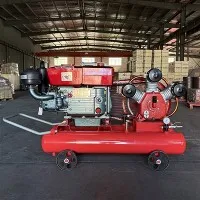
At Moderate Machine, our engineering philosophy centers on "Technical Balance". We don't push machines to extreme, unsustainable limits, nor do we compromise on durability. For light-duty, intermittent sandblasting (such as spot rust removal or small component cleaning), a heavy-duty, professionally calibrated portable diesel piston compressor is highly efficient and perfectly viable.
-
Heavy-Duty Piston Compressors Engineered for Tough Fields
To bridge the gap between portability and demanding pneumatic workloads, we manufacture robust, field-tested piston air compressors engineered with optimized cooling systems and heavy-duty casting components to support versatile operations.
1. W-1.8/5 Diesel Motor Mini Piston Air Compressor (11kW)
Displacement: 1.8 m^3/min (63.5 CFM)
Maximum Pressure: 5 Bar
Application: Powered by a reliable 11kW diesel motor, this unit delivers excellent CFM output for mobile, light-to-medium sandblasting jobs and rock drill operations in remote areas without grid power.
2. W-3.2/7 Mine Portable Diesel Piston Air Compressor
Displacement: 3.2 m^3/min (113 CFM)
Maximum Pressure: 7 Bar
Application: Specifically engineered for mining and rugged terrain. Its massive 113 CFM air delivery easily maintains stable pressure for medium-duty sandblasting applications and multiple pneumatic tools simultaneously.
3. 2V-3.5/5 Mobile Diesel Piston Air Compressor
Displacement: 3.5 m^3/min (123.6 CFM)
Maximum Pressure: 5 Bar
Application: Featuring a heavy-duty 2V piston head configuration, this high-displacement mobile unit provides the stable, high-volume airflow required for continuous large-scale surface cleaning and rust removal.
Essential Considerations When Using a Piston Compressor for Sandblasting
If your budget or field mobility dictates the use of a diesel or electric piston compressor for sandblasting, implementing the following technical configurations will significantly optimize your performance and equipment lifespan:
- Implement High-Efficiency Air Treatment: Sandblasting media is highly sensitive to moisture. Frictional heat from a running piston compressor creates water condensation in the air lines, which can clog the abrasive mixing valve. Installing an industrial oil-water separator and air dryer is mandatory.
- Enlarge the Air Storage Vessel: Utilizing an external auxiliary air receiver tank acts as a pneumatic buffer. It stores volume, dampens pressure drops, and allows the piston compressor to cycle on and off naturally, preventing heat exhaustion.
- Strict Adherence to Preventive Maintenance: Given the dusty environment of sandblasting sites, monitor and replace air filters frequently. Check the lubrication oil level daily to protect the crankshaft and piston rods from micro-abrasive wear.
Conclusion
Can a small piston compressor be used for sandblasting? Yes, provided its displacement (m^3/min or CFM) is technically matched to your blasting nozzle diameter and the work is scheduled around the machine's cooling duty cycle. For small-scale mining support, structural spot cleaning, and mobile maintenance, a robustly engineered diesel piston compressor offers an unbeatable balance of cost, mobility, and utility.
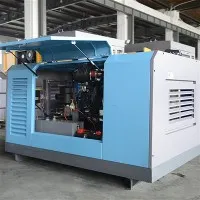
For continuous, heavy-duty 24/7 industrial sandblasting over expansive surface areas, migrating to a rotary screw compressor is recommended to achieve peak operational efficiency.
Explore our durable Piston Air Compressors to find the perfect balanced power for your project.
📚 References
ASME PTC 9-2004, Performance Test Code on Compressors and Exhausters
ISO 1217:2012, Compressed air - Acceptance tests