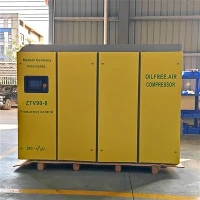
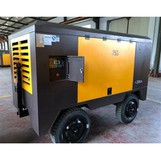
Selecting the optimal compressor configuration is a pivotal procurement decision that directly governs your job site's energy efficiency, initial capital expenditure, and long-term operating costs. At Moderate Machine (Quzhou Zhongdu Machinery Technology Co., Ltd.), our engineering philosophy centers on designing "Sensible Machines"-industrial equipment that achieves the perfect balance between performance, durability, and lifetime fuel economy, without over-engineering or cutting corners.
When navigating the mobile rotary screw air compressor market for mining, construction, or water well drilling, the core technical debate often revolves around single-stage versus two-stage compression systems. This professional guide breaks down the engineering differences, operational trade-offs, and application suitability for both configurations.


1. The Core Engineering Mechanics
The fundamental variance between these two systems lies in how the atmospheric air is pressurized within the rotary screw air end.
Single-Stage Compression: In a single-stage mobile screw compressor, the atmospheric air enters the air end and is compressed to its final working pressure through a single rotation cycle of one male and one female rotor pair.
Two-Stage Compression: A two-stage compressor divides the workload across two distinct air ends arranged in a series. The first-stage rotors compress the atmospheric air to an intermediate pressure level. The air then passes through an interstage cooling system before entering the second-stage rotors, where it is pressurized to its ultimate discharge target.
2. Efficiency, Temperature, and Thermodynamic Behavior
The thermodynamic process determines how much energy is consumed to deliver a specific volume of compressed air.
The Volumetric Efficiency Advantage: When air is compressed, it generates significant heat. In a single-stage machine, as the compression ratio increases, the internal temperature rises sharply, which reduces the density of the air and lowers the machine's volumetric efficiency. Two-stage systems counter this via interstage cooling. Cooling the air between stages reduces its volume before it enters the second stage, requiring less mechanical power to complete the cycle.
Energy Consumption: Because the workload is split, a two-stage compressor operates much closer to an isothermal compression process. At high working pressures (above 10 Bar or 145 PSI), a two-stage mobile compressor can save up to 12% to 15% in fuel or electricity consumption compared to a single-stage unit delivering the exact same air volume.
3. Pressure Output and Flow Rate Capacities
Single-Stage Limits: Single-stage compressors excel in low-to-medium pressure applications. They typically top out at a maximum discharge pressure of 7 to 10 Bar (100 to 145 PSI). Pushing a single-stage rotor past these parameters drastically increases internal air slippage (blow-by) and thermal strain.
Two-Stage Capabilities: For demanding industrial applications requiring high-pressure output-such as deep water well drilling rigs (like the FYL200) or open-pit mining operations-stable pressures of 12 to 18 Bar (174 to 260 PSI) or higher are mandatory. Two-stage compressors effortlessly sustain these high pressures while delivering a superior, uninterrupted air flow rate (CFM).
4. Financial Capital Balance: Upfront Cost vs. Total Cost of Ownership (TCO)
Single-Stage Units: These machines feature a streamlined mechanical design with fewer moving parts, making them highly cost-effective to purchase upfront and easier to maintain for teams without specialized technical training.
Two-Stage Units: Carrying dual air ends and intricate cooling networks, two-stage compressors require a higher initial capital investment and more rigorous maintenance schedules. However, for continuous, heavy-duty operations, the substantial reduction in monthly fuel or energy bills quickly offsets the initial procurement premium, lowering the project's overall Total Cost of Ownership.
5. Application Matrix: Matching the Machine to the Project
To optimize your fleet asset allocation, align the compressor type with your specific site infrastructure:
Single-Stage Application Suitability
General Construction Sites: Perfect for powering light-to-medium pneumatic infrastructure tools, small sandblasting kits, or utility blowers.
Pneumatic Distributing: Highly effective when supplying air to standard hand-held or air-leg rock drills (such as the YT27 Jack Hammer) in shallow or small-scale tunneling where pressure demands remain under 10 Bar.
Two-Stage Application Suitability
Deep Well Drilling: Critical for deep water well excavation where high pressure is required to clear heavy cuttings and mud from holes measuring 40 to 60 meters deep.
Heavy-Duty Mining: Designed to drive large-scale DTH (Down-The-Hole) drilling rigs operating in ultra-hard rock strata where penetration speeds depend entirely on high-volume, high-pressure air delivery.

Conclusion
The choice between single-stage and two-stage mobile screw compressors comes down to balancing your actual site pressure requirements with your operational duty cycles. For low-pressure, intermittent tasks, a single-stage unit delivers exceptional utility and simplicity. For deep-hole drilling and continuous mining operations, a two-stage machine is an indispensable asset for cutting fuel costs and maximizing production speeds.
Supported by an ISO 9001 certified quality management system and field data compiled across 50 countries, Moderate Machine supplies precision-engineered, job-matched air solutions built for maximum reliability under extreme field constraints.
Explore our 75kw Mobile Electric Rotary Screw Air Compressor for Mining