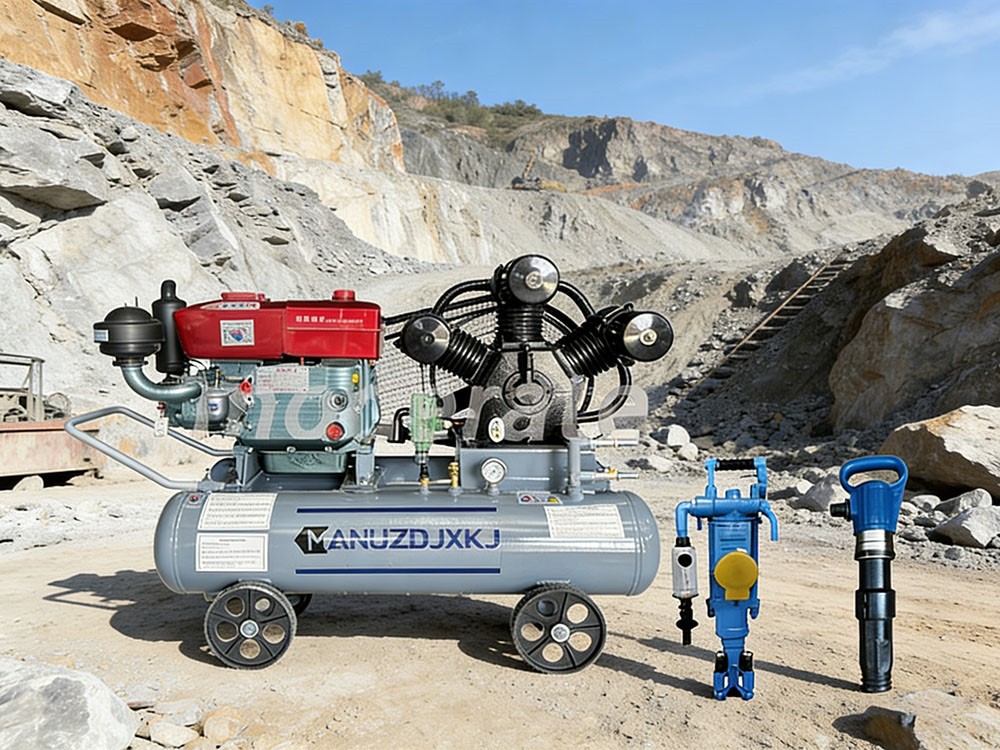
In mining operations, tunnel excavation, and road construction, the pneumatic rock drill and the diesel piston air compressor form a "perfect pair". The former is responsible for breaking the rocks, while the latter provides the power source for the former. The two work closely together through the compressed air system to complete the drilling tasks.
I. Supporting Working Principle
The diesel piston air compressor is the "heart" of the entire system. The diesel engine drives the piston of the compressor to move back and forth, drawing in air and compressing it to a pressure of 0.5 - 0.7 megapascals, converting it into high-pressure gas. This compressed air is stabilized by the storage tank and transported through the pipeline to the rock drilling machine, driving its internal piston to move rapidly back and forth at a frequency of more than 2000 times per minute, impacting the drill bit with each strike, thereby achieving rock breaking and drilling.
II. Key Points for Model Selection
The critical parameter for matching is "air volume matching". The air consumption of a medium-sized pneumatic leg drill is approximately 2.5 - 3.5 cubic meters per minute. Therefore, the exhaust volume of the air compressor should be slightly higher than this value. Typically, the selection is based on providing an exhaust volume of 3 - 4 cubic meters per minute per drill. Regarding pressure, the working pressure of the drill is generally 0.4 - 0.6 megapascals. The rated pressure of the air compressor needs to be 0.15 - 0.2 megapascals higher to compensate for the pressure loss during the pipeline transmission process.
III. Key Points for On-site Use
When connecting on-site, the air compressor should be placed at the center of the gas consumption load. The pipeline should be laid using steel pipes and a slope should be set to facilitate the drainage of water at the lowest point. An oil injector needs to be installed at the front end of the rock drilling machine to ensure that the compressed air carries a mist of lubricating oil, thereby achieving adequate lubrication inside the machine. Before each shift of work, it is necessary to check whether the pipe joints are leaking and whether the safety valve is sensitive. The storage tank should be drained regularly to prevent water from entering the rock drilling machine and causing rust.
IV. Advantages and Application Scenarios
Diesel piston air compressors do not rely on grid power supply and are highly mobile and flexible. They are particularly suitable for construction operations in areas without electricity. The entire system has a simple structure, is easy to maintain, and has strong environmental adaptability. It is widely used in engineering fields such as mines, tunnels, and water conservancy and hydropower projects. As long as the selection is appropriate and regular maintenance is done properly, this "golden pair" can stably and efficiently complete various hard rock drilling tasks.