The Screw air Compressor Consumes Too Much Fuel? Six Inspection Steps Can Help You Save Money and Reduce Consumption
During the daily operation of diesel screw compressor machine, excessive fuel consumption is a common and troublesome issue. It not only increases the cost of lubricating oil procurement, but also may lead to excessive oil content in the exhaust gas, thereby polluting the downstream gas-using equipment and affecting product quality. When you notice that the fuel consumption of the air compressor has increased abnormally, there is no need to rush to replace major components. Instead, you can systematically investigate the problem following these six steps, and often you will be able to identify the root cause.
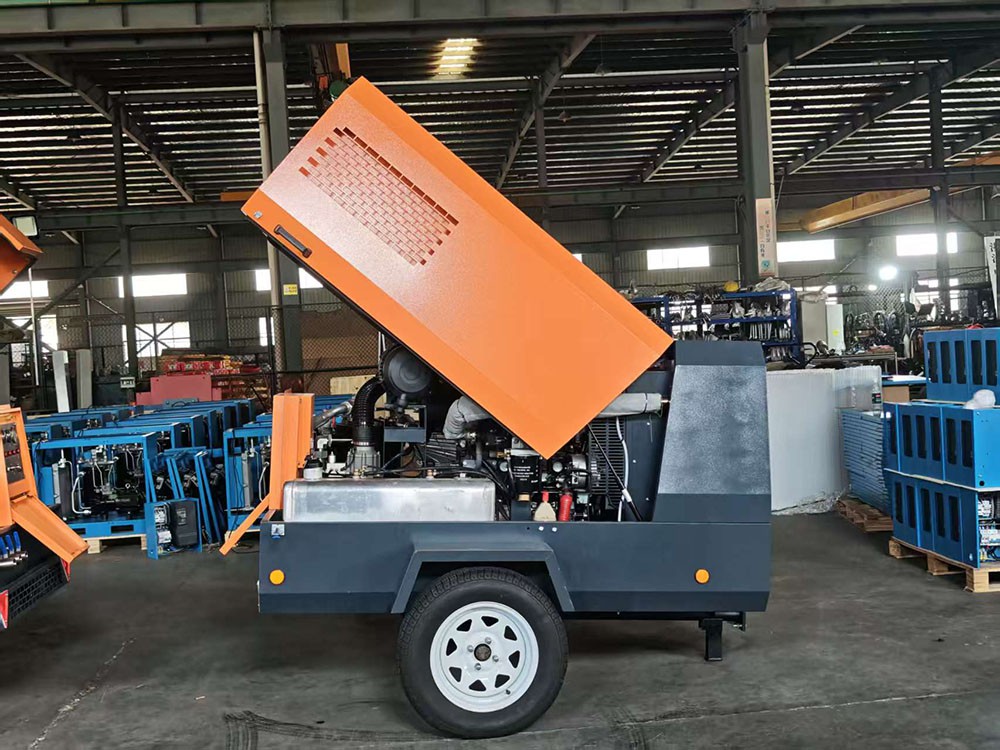
The first step is to inspect the secondary return oil pipeline. The return oil pipe and the one-way valve are responsible for redirecting the lubricating oil accumulated at the bottom of the separator back to the machine head. If the pipeline is clogged or the one-way valve is stuck, the oil cannot flow back and can only be expelled along with the compressed air. At this point, the return oil pipe and the one-way valve should be removed, and then blown clean with high-pressure air or soaked in cleaning agent for cleaning.
Step 2: Check for leaks in the lubrication system. External leaks are easy to detect, but tiny cracks in the high-pressure oil lines or loose connections can also cause hidden fuel consumption. Carefully inspect the pipes, joints, and seals. If any leakage traces are found, they must be promptly repaired or replaced.
Step 3: Inspect the filter element of the oil-gas separator. If the filter element is damaged or has aged and failed, the oil and gas mixture cannot be effectively separated, and a large amount of lubricating oil will directly enter the exhaust pipe. If the filter element has reached its service life or is found to be damaged during inspection, it should be replaced immediately with a genuine filter element.
Step 4: Confirm whether the system pressure is normal. If the system pressure remains consistently low for a long time, the oil-gas separation efficiency will significantly decrease. At this point, it is necessary to check whether the minimum pressure valve has opened prematurely or become stuck, as well as whether the throttle holes in the muffler are clogged or deformed. Corresponding repairs should be carried out.
Step 5: Check the amount of oil added. Many maintenance workers are accustomed to "filling up" when changing the oil, but excessive oil will be carried away by the high-speed airflow. After stopping the machine, observe the oil level gauge and keep the oil level between the upper and lower scale lines. If it exceeds the upper limit, the excess oil should be drained.
Step 6: Pay attention to the drainage of condensate water. If there is excessive condensate water accumulated inside the compressor, it will occupy the volume of the oil tank and cause the oil level to appear falsely high. Some oil-water mixtures are prone to be carried away by the airflow. Regularly open the drain valve to fully discharge the condensate water, especially in humid environments, the frequency of drainage should be increased.
In conclusion, excessive fuel consumption of the compressor is often the result of the combined effect of multiple factors. By following the principle of "starting with the simple and progressing to the complex, starting from the outside and then moving to the inside", conducting a step-by-step investigation can not only quickly solve the problem but also effectively reduce maintenance costs.