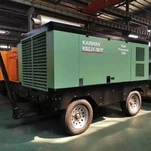
How to Choose a Diesel Piston Air Compressor for Rock Drills and Pneumatic Breakers
On mine benches, tunnel faces and demolition sites, the most productive tools are often pneumatic: rock drills hammering the face, air picks chipping concrete, breakers tearing up pavement - and all of them hang on one lifeline, the air compressor. Yet many buyers size that compressor for a drilling rig, or guess by engine power, ending up with throttled tools or wasted diesel.
A diesel piston air compressor built specifically for pneumatic-tool work changes that. This guide shows how these machines differ from drilling compressors, how to size airflow and pressure from your tool list - and how one production range, the W-Series (1.35–4.0 m³/min at 5 or 7 bar), maps onto real rock-drilling and breaking jobs.

First, Know What You Are Powering: Pneumatic Tools, Not a Drilling Rig
The most common mistake in mining and construction is confusing two completely different compressed-air jobs:
Drilling rigs - DTH hammers and top-hammer drill heads need high-pressure, high-volume air, typically 1.5–3.5 MPa, delivered continuously. That is the territory of large rotary-screw packages.
Pneumatic tools - rock drills, air picks, pneumatic breakers, chipping hammers - work at 0.5–0.63 MPa with demands of roughly 1–4 m³/min per tool. This middle ground is exactly where the piston compressor belongs.
A diesel piston air compressor makes sense next to pneumatic tools on three counts: far lower first cost than screw packages at this capacity, simple construction a site mechanic can repair, and grid independence. Feeding these tools from a drilling-grade screw compressor means paying for pressure and flow you never use.
Size Airflow from the Tools You Actually Run
Airflow - free air delivery (FAD) - decides everything. In metric markets, delivery is rated in m³/min (1 m³/min ≈ 35.3 CFM). Typical consumption at 0.5–0.63 MPa:
Air picks / light breakers (chipping hammers): roughly 0.9–1.6 m³/min each.
Handheld rock drills (YT24C class): about 2.7 m³/min.
Air-leg rock drills (YT28 class): about 3.3 m³/min.
Rule: add the consumption of every tool you run at the same time, then add a 20–30% margin - a pump that runs flat-out all shift overheats and wears fast.
Worked examples:
One handheld rock drill (2.7 m³/min) with margin → a W-3/5 or W-3.5/5 (3.0–3.5 m³/min).
One handheld drill plus one air pick run alternately → still the 3.5 m³/min class, sized to the largest simultaneous load.
One YT28-class air-leg drill (3.3 m³/min) with margin → a 4.0 m³/min machine such as the SF4.0/5 or 2V-4.0/5. If you must also blow the hole clean while drilling, alternate operations or move up a size.
Two air picks or breakers together (about 2.4 m³/min combined) → a W-2.8/5 covers it comfortably and still runs a single handheld drill.
Match Pressure: 5 Bar for Standard Tools, 7 Bar for Margin
All the tools above are rated at 0.5–0.63 MPa. That is why the W-Series comes in two pressure ratings, marked by the number in each model name: /5 = 0.5 MPa (5 bar, ≈72 psi) and /7 = 0.7 MPa (7 bar, ≈100 psi).
Choose the 5-bar versions for standard rock-drilling and breaking duty. Choose the 7-bar W-3.2/7 when you need headroom: long hose runs that bleed pressure, high-altitude sites, cold weather, or worn tools that need extra push at the inlet. What you do not need is drilling-grade pressure - oversupplying a rock drill only accelerates wear and wastes fuel.
Why Diesel - and When Electric Makes Sense
A mine diesel piston air compressor earns its keep wherever the work face moves and the grid does not reach: open-pit benches, quarry floors, road crews, remote tunnelling camps. The W-Series' single-cylinder air-cooled diesels (S1100–S1125 range, 11–18.5 kW) start anywhere, fuel from any supplier and are maintained with basic hand tools. Two field notes:
Altitude: above about 2,000 m, both engine power and output fall (roughly 3% per 300 m) - confirm derating with the manufacturer, and prefer the 7-bar version for margin.
Cold starts: in winter, fit a cold-start aid and use winter-grade diesel; the /7 model's headroom also helps cold, sluggish air systems.
Where three-phase power is reliable - workshops, maintenance bays, indoor sites - every model is also offered with an 11–18.5 kW electric motor: quieter, cleaner and cheaper per running hour.
The W-Series at a Glance
All models are portable piston air compressor machines on wheeled or skid frames, horizontal or V-type cylinder layouts, with diesel or electric drive.
|
Model |
Air Delivery (m³/min) |
Pressure (MPa) |
Cylinders (dia × qty) |
Diesel Engine / Motor |
|
W-1.35/5 |
1.35 |
0.5 |
100 × 3 |
S1100 diesel / 11 kW |
|
W-1.8/5 |
1.8 |
0.5 |
100 × 3 |
S1100 diesel / 11 kW |
|
W-2.8/5 |
2.8 |
0.5 |
115 × 3 |
S1110 diesel / 15 kW |
|
W-3/5 |
3.0 |
0.5 |
120 × 3 |
S1115 diesel / 15 kW |
|
W-3.5/5 |
3.5 |
0.5 |
125 × 3 |
S1115 diesel / 18.5 kW |
|
SF4.0/5 |
4.0 |
0.5 |
120 × 4 |
S1115 diesel / 18.5 kW |
|
W-3.2/7 |
3.2 |
0.7 |
125 × 3 |
S1125 diesel / 18.5 kW |
|
2V-4.0/5 |
4.0 |
0.5 |
120 × 4 |
S1125 diesel / 18.5 kW |
Suggested pairings: W-1.35/5 or W-1.8/5 for a single air pick plus blow-cleaning and inflation; W-2.8/5 or W-3/5 for one handheld rock drill or two air picks; SF4.0/5 or 2V-4.0/5 for one YT28-class air-leg drill on continuous duty; W-3.2/7 for the same jobs with long hoses, altitude or cold climate.
Explore our diesel piston air compressors