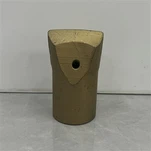
Why the Cheapest Tapered Button Bits Always End Up Costing More
- There is a number that most drilling teams track: the price per bit.
- There is a number that actually determines profit: the cost per meter drilled.
These two numbers are rarely the same. In fact, for buyers who source tapered button bits purely on unit price, the gap between them is often where project margins disappear.
This guide breaks down how to evaluate taper button bits the way experienced drilling managers do - not by the invoice, but by what each bit actually delivers underground.
What a Tapered Button Drill Bit Actually Does
A tapered button drill bit transmits rotational and percussive energy from a pneumatic rock drill through a tapered shank connection - no thread, no coupling adapter. The tungsten carbide buttons are hot-pressed directly into the bit face, which gives this design its penetration advantage over cross bits and chisel bits in medium-to-hard rock.
The taper connection (standard angles: 7°, 11°, 12°) is what defines the system: the bit and rod lock together under drilling pressure and release cleanly on reverse rotation. It is a mechanically simple, field-repairable connection - which is one reason the tapered system still dominates small-hole drilling from 26mm to 48mm globally, even as threaded systems have taken over larger-diameter work.

Key specifications that determine field performance:
| Parameter | Typical Range | What It Affects |
|---|---|---|
| Bit diameter | 26mm – 48mm | Hole size, application match |
| Taper angle | 7° / 11° / 12° | Rod compatibility, energy transfer |
| Button type | Spherical / Ballistic / Parabolic | Rock hardness suitability |
| Carbide grade | Binder content (Co%) | Wear resistance vs. toughness tradeoff |
| Skirt coating | Zinc-plated / Bare | Friction reduction, rod interface life |
The 32mm tapered button bit sits in the most common size range for mine secondary blasting, rock bolting, and small-tunnel drifting - the same applications where procurement decisions get made in bulk and where per-unit pricing looks most attractive.
The Procurement Mistake That Costs More Than You Think
Consider two tapered button drill bit options a procurement manager receives:
Bit A: $4.80/unit. Bit B: $7.20/unit.
On a 500-unit order, Bit A looks like a $1,200 saving. That math is straightforward.
Here is the math that does not appear on the quotation:
Bit A comes from a supplier using standard carbide with inconsistent binder content. Average penetration rate in f = 8–10 rock: 0.20 m/min. Bit life before re-sharpening or replacement: 80 meters. Cost per meter: $0.06.
Bit B uses premium hot-pressed carbide with verified button geometry. Penetration rate: 0.30 m/min. Bit life: 140 meters. Cost per meter: $0.051.
On a project drilling 50,000 meters:
- Bit A total bit cost: $3,000 (625 bits × $4.80)
- Bit B total bit cost: $2,571 (357 bits × $7.20)
Bit A is cheaper per unit. Bit B is cheaper per meter drilled - and it completed the same meterage 19% faster, which on a labor-billed or equipment-rental job is where the real money is.
This calculation - cost per meter drilled - is what separates transactional procurement from strategic sourcing. Button bits with lower carbide quality also create a secondary cost: they fail non-uniformly, meaning some bits in a batch underperform, which disrupts drilling schedules and forces teams to carry larger buffer inventory.
Matching the Bit to the Rock: The Selection Logic That Prevents Both Under- and Over-Specification


The most common field error is not buying too cheap. It is buying the wrong specification for the rock condition - in either direction.
- For hard, abrasive rock (f = 10–16):
Choose a carbide grade with lower cobalt binder content (harder, more wear-resistant). Spherical buttons hold geometry longer under high-impact percussion. Taper angle selection should prioritize rod stability - 11° or 12° taper for most pneumatic jack hammer setups. - For medium-hard rock (f = 6–10):
This is where the tapered button bit outperforms both chisel bits and cross bits in cost-per-meter terms. Ballistic or parabolic button geometry improves chip clearance and reduces re-drilling of collars. A 32mm button rock drill bit running at the correct air pressure (0.5–0.6 MPa) in this hardness range is typically the most economical drilling configuration available. - For softer or fractured rock:
Penetration rate is rarely the constraint. Bit retention and gauge wear become the priority. A zinc-plated skirt reduces friction losses at the rod interface and extends bit life in conditions where the taper connection is stressed by irregular hole geometry.
One operational point that is often ignored: taper angle compatibility between the bit and the rod must be verified before procurement, not after delivery. A 7° taper bit on an 11° rod does not merely underperform - it damages both components from the first stroke.
Operational Practices That Determine Whether a Good Bit Delivers Good Results
The best button rock drill bit on the market will wear prematurely under the wrong operating conditions. These are the practices that protect your investment:
- Before drilling begins: inspect the taper tip and taper hole fit. A worn or improperly matched connection dissipates percussion energy into the connection rather than the rock face. Check that water holes are clear - a blocked flush channel causes rapid button overheating and premature carbide fracture.
- During drilling: start at reduced air pressure and allow the bit to stabilize in the collar before advancing to normal operating pressure. Forcing penetration rate in the start phase is the single most common cause of early gauge wear and button chipping.
- When withdrawing: use reverse rotation wherever the drill rig permits. Impact-only withdrawal without rotation forces the bit out of the hole in a way that stresses the taper connection asymmetrically and accelerates rod wear as well.
- Between shifts: store bits face-down or in a padded rack. Button-to-button contact chips carbide inserts without any rock contact - a form of damage that is entirely preventable and entirely avoidable with basic site organization.
These practices apply regardless of bit brand or price point. Their return on investment is proportional to the quality of the bit: a well-specified button rock drill bit maintained correctly will outperform a premium bit run poorly every time.
The Case for a "Moderate" Approach to Bit Procurement
Moderate Machine was built on a specific observation: in the mining and drilling equipment market, procurement decisions tend to polarize. Buyers either chase the lowest unit price - and absorb the hidden costs described above - or they over-specify premium equipment for applications where that specification cannot return its cost premium.
The name "Moderate Machine" reflects this deliberately. In Chinese, 中度 (zhōng dù) carries the meaning of precision calibration - not median, not compromise, but the point at which performance and operating cost are in optimal balance for the actual working condition. The same philosophy that informs the company's air compressor and jack hammer design - engineered for the job, not engineered for the spec sheet - applies to its drilling tools.
The 32mm tapered button bits produced at the Quzhou facility are designed for the geological conditions and air supply pressures common across the company's primary markets: mine secondary blasting operations in South America, rock bolting and construction in Africa, and small-tunnel drifting in Southeast Asia. These are not conditions that require the most expensive carbide grade available. They require consistent carbide quality, reliable taper geometry, and hot-pressed button retention that holds through a full shift at 0.5–0.6 MPa operating pressure.
That is what "moderate" means in a drill bit: not a compromise, but a calibration.
Integrating the Right Drill System
A tapered button bit performs as part of a system. The bit specification only delivers its rated performance when it is matched to compatible drill rods, the correct air supply pressure, and a rock drill with an appropriate impact energy output for the target formation.
For operations using pneumatic jack hammers in the 20–30 kg class - the standard configuration for mine secondary blasting and rock bolting in the 32–42mm hole diameter range - Moderate Machine supplies matched tapered drill rods and jack hammer models designed to work within the same operating parameters as the button bit product line. Sourcing the drilling system from a single supplier also simplifies technical troubleshooting: when penetration rate drops or bit life falls short of expectation, the variables are fewer and the diagnosis is faster.
Summary: What to Evaluate Before the Next Bit Order
Before placing the next procurement order for taper button bits, these are the questions that determine whether the purchase is actually economical:
- What is the target rock hardness (f-value), and does the carbide grade match it?
- What taper angle does the drill rod system use, and is the bit geometry compatible?
- What is the realistic bit life expectation in meters, not hours?
- What is the cost per meter at that bit life - not the cost per unit?
- Is the button retention method specified (hot-pressed vs. interference-fit)?
- Does the supplier offer consistent batch quality, or does performance vary between shipments?
The answers to these questions determine the real cost of the drill bit. The unit price on the quotation determines the appearance of savings.
For operations where downtime is a direct cost and meterage targets are tracked daily, the difference between the two matters more than the difference in invoice total.

Find the Right Bit for Your Rock
Every formation is different. Tell us your drilling diameter, rock hardness, and air pressure - we'll recommend the right tapered button bit specification and match it to your drill rod system.
No hard sell. Just the right answer.